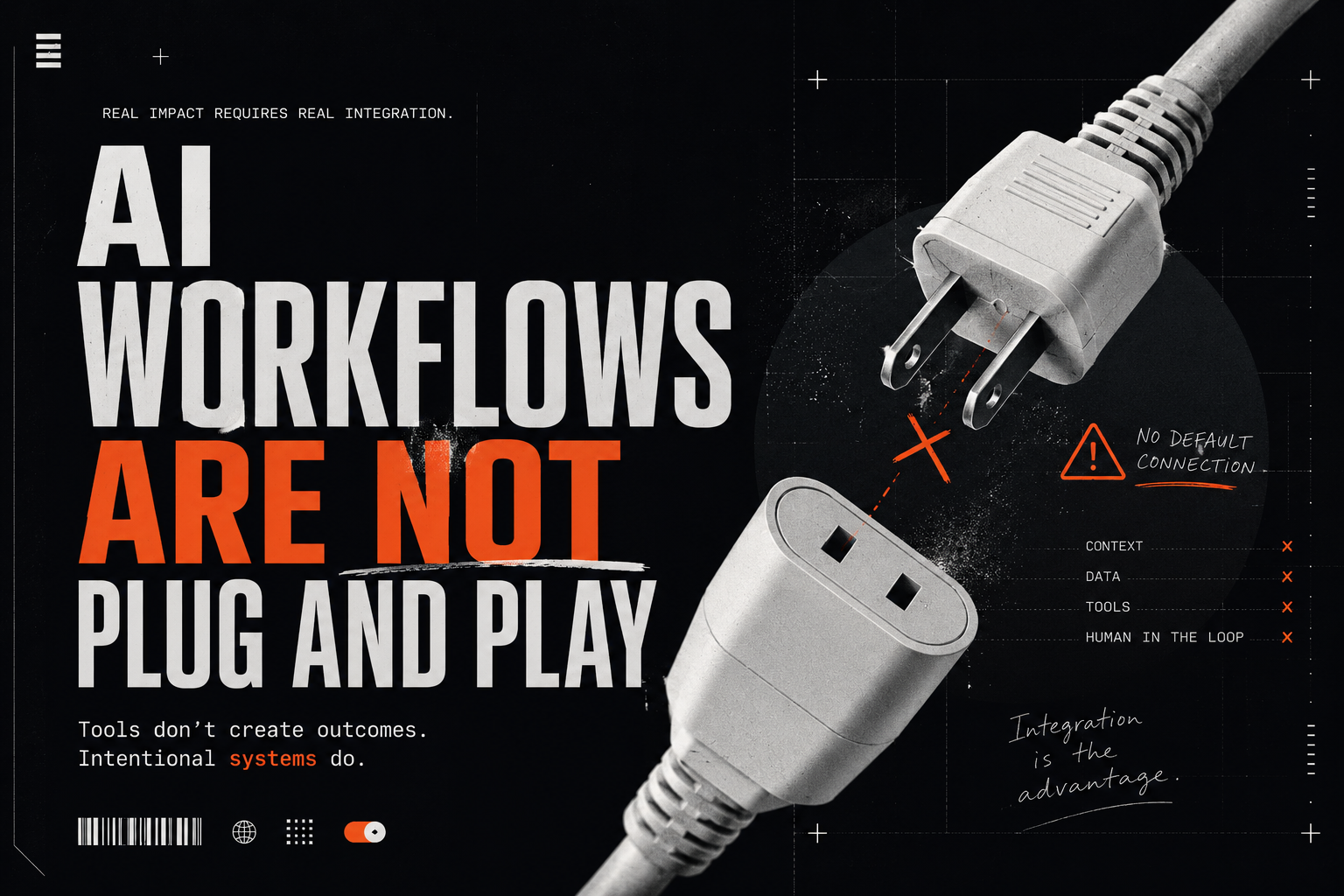
Everyone talks about AI automation like it is a magic switch. Flip it on, and suddenly the messy parts of your organization become clean. Emails answer themselves. Reports write themselves. Donor follow-up appears in the CRM. The team gets time back and everybody goes home earlier.
That is a nice story.
It is also not how this works.
AI workflows are not plug and play because most organizational workflows are not actually workflows. They are habits. They are exceptions. They are three people remembering to do something because the last time they forgot, it hurt. They are Google Docs with unclear owners, meetings that exist because nobody trusts the handoff, and information living in the head of the one person who has been there long enough to know where everything is buried.
AI does not fix that automatically. It exposes it.
The demo always looks clean because the demo has clean inputs. Real teams have half-written notes, inconsistent naming, missing context, unclear approval paths, and a dozen tiny judgment calls that never made it into the process document because there is no process document.
That does not mean AI is overhyped. It means implementation is the work.
The first step is not choosing a tool. The first step is naming the path work already takes. Where does a request begin? Who decides what matters? What information is needed before someone can act? Where does work stall? What has to be reviewed by a human? What should never be automated because the risk is relational, ethical, or just not worth it?
For lean ministry and nonprofit teams, this is where the real opportunity lives. Not in replacing people. In reducing the amount of repetitive coordination that keeps people from doing the work only they can do.
A good AI workflow starts boring. That is a compliment. It takes one repeatable task and makes it clearer. A meeting transcript becomes a recap with owners and deadlines. A discovery call becomes a structured brief. A messy list of website edits becomes tickets. A donor story interview becomes a first-pass outline, with the sensitive parts flagged for human review.
None of that is flashy. All of it is useful.
The mistake is trying to automate the whole machine before you understand the machine. Teams jump from curiosity to complexity too fast. They connect six tools, set up a chain of prompts, and then spend the next month debugging why the output is technically correct but contextually weird.
Start smaller.
Pick one workflow that happens every week. Write down the current steps. Identify the part that is repetitive, structured, and low risk. Let AI assist there. Keep a human at the decision point. Review the output. Improve the prompt. Improve the source material. Improve the handoff.
And pay attention to trust. If the team does not understand what the system is doing, they will work around it. If the output creates more review burden than it removes, they will abandon it. If the workflow saves time for one person by creating confusion for three others, it is not a workflow. It is a transfer of pain.
The best AI systems feel almost quiet. They do not ask everyone to change everything. They remove friction from a known path. They make the next step easier to see. They give people a better starting point.
That is the part worth building toward.
AI is not a magic switch. It is leverage. And leverage only helps if you know where to place it.
So before you buy another tool, map the work. Before you automate, clarify. Before you hand off judgment, decide where judgment belongs.
The future probably will include more agents, more integrations, and more work happening in the background. But the organizations that benefit will not be the ones with the longest tool list.
They will be the ones that understand their own work well enough to teach it.